Monday, 15 June 2009

No Future

What would I like to be doing five years from now? Ok, ok, but... Five years from now! Isn't that too much time? In fact, it's enough time to become another guy, or maybe to be dead.
I think -actually- that I will be studying yet. Or maybe beginning a brilliant career as an art historian (just kidding). Well, after all, I think it wouldn't be bad to be a kind of humanist, or a researcher or something like that. Personally, I hope I'm having a good time without working so hard.

I was (also) asked to write about my ideal future. How can I imagine an ideal future, if in a few years from now we'll be in a wicker world? Ok, I hope it isn't becoming that bad, of course, but I can't imagine a beautiful and happy future. But, anyway, I'll try to write something. Of course, thinking it's not about reality.

. . .

My ideal future

In five years from now I'd like to be living in an old house, by my own, with enough money but without a job, so I'd have a lot of free time. The money must come for the rents of a couple of properties. So I'd be able to drink some fine liquors, and beer, and wine, of course. I'd meet some friends and we'd make some little gigs together, with good music and some drink. I'd paint in oils sometimes, and I'd read and listen to music as much as I can.
Isn't that an ideal future?

Monday, 8 June 2009

Favorite subject...

I've been asked to describe my current favourite subject in my 'career'. I don't know why, but it sounds a kind of deja vu for me. I think I wrote something about it before.


Anyway, I can say that my fav subject now is called "Vanguardia, escritura y ciudad" (I'm not sure that's the right order, but it would be something like "Avant-garde, writing and metropolis"). It is basically Theory of avant-garde art movements through the XXth century, and their relationship with several disciplines of thought and textual production, the progressive placement of the artistic activity into the big cities (as considered after the theory developed by Charles Baudelaire, the metropolis as the definitive wagnerian "total artwork" -Gesamtkunstwerk, in German).
Maybe the main matter in this subject is the complex relationship between Aesthetics (Arts), Technique, Politics and Society. The teacher is professor Carlos Ossa.

I like it because of the conceptual strenght that must be -necessarily- employed on it, in a complex discourse that must involve several subjects such as Sociology, Capitalism, advertising analysis, Theory of merchandising, Theory of images, etcetera.

And well, I learnt a lot this semester: some things about Impressionism, Expressionism, Surrealism, avant-garde in general, Cinema and of course, some interesting points related to Politics.

Monday, 1 June 2009

The Greatest?


My English teacher asked me (actually, she asked us all in the class) to write about "who's the best on my field". Ok, but... My field? I suppose it has something to do with Arts, since I study Theory of Art (apart from that, I don't have a job nor anything like that). But, What kind of person in particular? An art historian, critic, or theorist? A philosopher? A man of letters? A musician? From the request for posting some images of his or her works, I deduced that the post must be about an artist in the most common sense of the term: a plastic artist, like a painter, a sculptor, a photographer, or a draftsman, and perhaps a moviemaker.

Well, in any case, it's hard to choose only one who may be called "the best" in his/her field, even in a subjective opinion. Personally, I have a lot of favourite artists, not necessarily between the best or most prominent artist of all times (in Western civilization, of course). Some of them are: Hans Bellmer, Max Ernst, Picabia, Joel Peter Witkin, Georg Grosz, Lucas Cranach, Hans Baldung Grien, Hans Holbein the Younger, Grünewald, Dürer, Giotto, Ingres, Watteau, Bernini, Arcimboldo, Vermeer, Hyeronimus Bosch, James Ensor, Magritte, Hopper, Turner, William Blake, Bramantino, Botticelli, Caravaggio, El Greco, Goya, Rembrandt, Van Gogh, Manet, Cézanne, Picasso, Tolouse-Lautrec, Raoul Dufy, Derain, Chaplin, Eisenstein, Basquiat... Norman Rockwell? Why not? (as you can see, most of them are painters).

Now, the canonical artists considered between the greatest of all times, are usually the same as always. I mean, Leonardo, Michelangelo, Raphael, Tiziano, Caravaggio, Velázquez, Rembrandt, Goya, Rodin, Van Gogh, Cézanne, Picasso... and, among them, some radical transgressors of the Idea of Art, now acclaimed: Malevich, Duchamp, Pollock, Warhol... But: who can I choose as 'the best' without repeating the same names? Hard question. Because all of them are, according to the tradition and the conventions (but also according to solid parameters), great and essential, or at least, very important artists. Ok, I'll choose one significant to me.

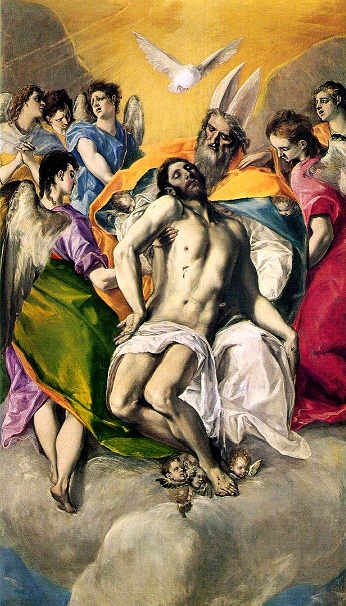
And my choice was: El Greco.

Domenikos Theotokopoulos, better known as El Greco was a Greek born artist from the XVIth and XVIIth centuries (Baroque period), who lived most of his life in Spain, where he made his best known artworks. He was one of the most original painters who ever lived, and nowadays his style is still easily recognizable: tall, long figures (some experts believed that it was because of vision problems, and some others even thought that the artist consumed marijuana), delightful and expressive colors, mystical force... He painted some masterworks of all times, such as "El entierro del Conde de Orgaz" (The burial of the Count of Orgaz), "Visión de Toledo" (View of Toledo), and "La visión del Apocalipsis".

I like El Greco because of his unique style, because of his use of colors and lights and shadows, and his creative force, full of mysticism and magnificence. His paintings are very dark, in some way, they have a kind of hidden force that makes them mysterious and charming.

I think that he could be named "the best" because of many reasons. Maybe the main one is that he was an irrefutable and absolutely genial precursor of very later art styles, centuries after he died, and in an unique, unmistakable, original way. His formal and stylistic originality, I think, has almost unprecedented (just a few previous artists can be compared with it: Hyeronimus Bosch, Pieter Brughel the Elder, Michelangelo, Arcimboldo, between them). El Greco prefigured some modern and avant-garde art movements such as Expressionism, Fauvism, Cubism, Modernism and Symbolism. His paintings are full of expression, religious sentiment, and force, almost violence. This is why El Greco can be considered, in my opinion, simply "the Best".

Friday, 15 May 2009

Favourite Website?


There are a fistful of websites I can consider as favourites of mine, or something like that. If I have to choose one of them... Mm... it may be another blog, "Il Canto Sospeso" (the name's because of the work by Italian composer Luigi Nono, about the battles between partisans and fascists). I've found it by searching music composed by Igor Stravinsky, one of my favourite classical composers, in google... then it links me to this blog, and, what a surprise: I found the complete Stravinsky Edition (in Sony), a box-set over 15 compact discs, with the works of the composer, conducted by himself, to download for free!. I downloaded it immediatly.
After downloading the complete box-set, I realized that it contained a lot of works of contemporary classical music (which is an important 'item' in my extensive musical taste). All those discs are very hard to find, and most of the links are still able to download, if you're interested.
I visit this blog as soon as I can, and I use to left my PC working, downloading some disc while I do some other things. Well, as I told you before I'm a big music lover, so this blog is a wonderful site for me, specially since I don't have enough money to buy discs.


P. S.
The link is: http://ilcantosospeso.blogspot.com/

Monday, 27 April 2009

On Theory of Arts


I told you before that I'm studying Theory of Art.

Why am I doing this?

Well I'm

not completely sure, but one first reason is: I have some free time by studying this, and that's an important point.

Second: I like Arts, I like to read and, a good point: this 'career' can be a good starting point to give you some knowledges concerning to other fields (Philosophy, Sociology, Anthropology, Politics, Archaeology, etc) of knowledge.

Well, I don't really know what will I do in the future. I don't even know if I'll continue studying in this field, or if I'll study another career, or if I'll leave university. I don't want starting work immediately after concluding this degree, and of this I'm sure.

What else can I say?

Art theorists or historians don't necessarily contributes directly to society (maybe they are, in some ways, dispensable in a basic one), but they inevitably work inside the system, by saying what is "a real artwork" and what isn't; by legitimizing some practices and valuing pieces of art; or by contributing to state cultural politics. Art theorist can also think about social and political problems starting from art-related thoughts.

An art theorist must know well, at least, some specific period in Art History. He/she must know the History of the different theories of art too, and must be conscious of the current problems concerning to Aesthetics, being capable to take part in present discussions.
I'm not sure about what is my favourite subject in this degree currently. Maybe one concerning on vanguards and problems related to it.

Monday, 20 April 2009

A nice holiday


I'll tell you about the city of Valdivia, which I visited twice in my life. Then it was placed in the 10th region of Chile, known as "Región de los Lagos" (Region of Lakes), but nowadays it's placed in a recently created region: the 15th, called "Región de los Ríos" (Region of Rivers), because Valdivia's population wanted to have their own regional district, and the name's because there are many big rivers. Valdivia itself is a city built around the river Calle-Calle, a very beautiful one.


I went there with my father the two times, and the last one (about six years ago) just before a great trip to Chiloe. Then we did many things: first, we spend a lot of time trying to find a place to stay in. Later, we ate in different places, drank Valdivian beer, walked around the river, bought some things, visited some interesting buildings and, of course, talked a lot about almost everything. By example: we talked about the 1960 earthquake, one of the most severe ever registered, and its consecquences to the city: almost every old building has been destroyed. Anyway, Valdivia is one of the most beautiful places I ever visited. The landscape the river brings is wonderful. I recommend you to go there someday.

Monday, 13 April 2009

Let me please introduce myself

Hi everybody. I'm Ignacio and I was born in 1987 in Santiago, Chile. I study Theory of Art (like the great Art Blakey's disc) at Universidad de Chile. I like arts very much, specially painting: but, anyway, music is that I like best. I really love music and I have an extensive musical taste. I like to read too: novels, poetry, tales, essays, History, Philosophy, etc. And maybe there's no many things more to tell about myself, but I hope I'll write some interesting things here. I hope I'll improve my poor English, too.

Greetings.
-Ignacio C.